
Advanced example
Multiple Unscheduled Pods
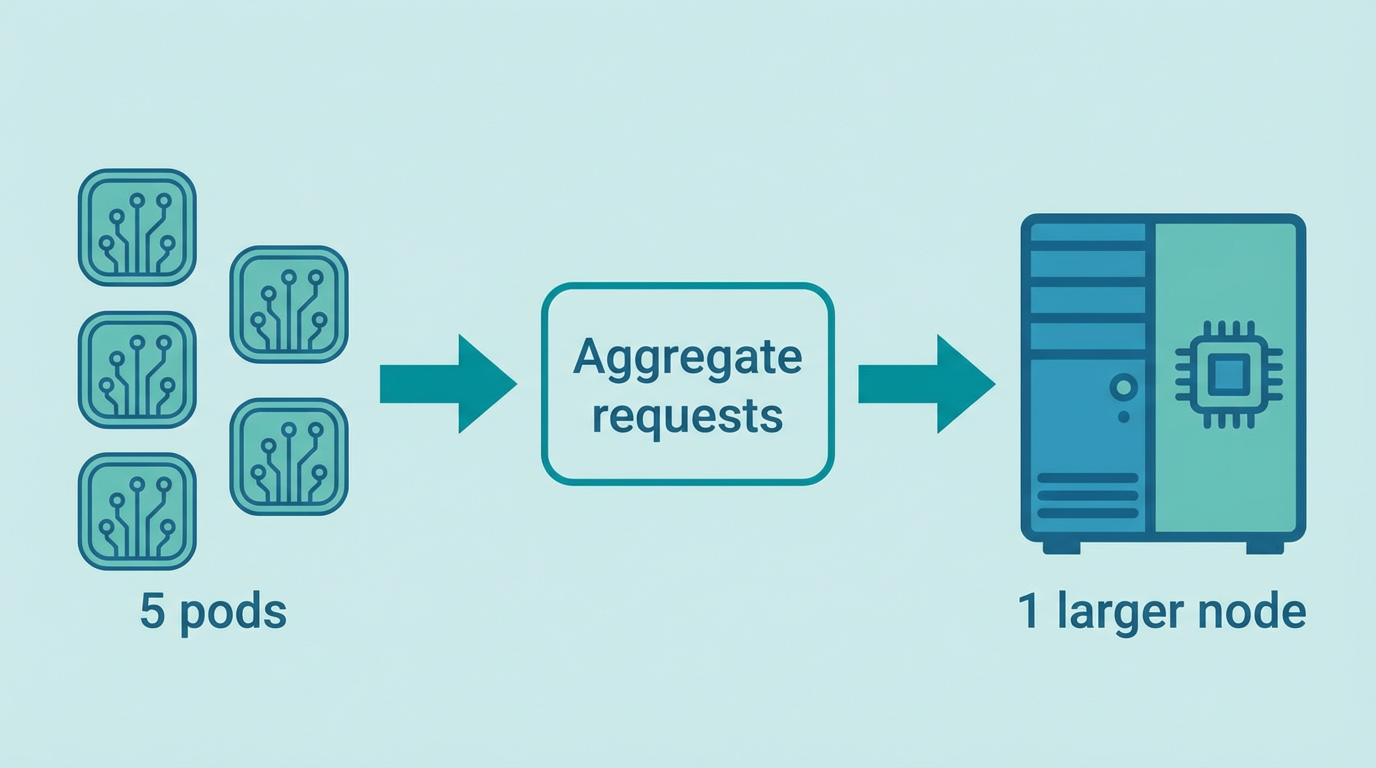
Demand aggregation: several pods trigger one larger node, not one node per pod.
When several pods are unschedulable at once, the NodePool controller handles them in one reconcile:
- Demand aggregation — CPU and memory requests are summed across all eligible unscheduled pods (Pending,
PodScheduled=False, reasonUnschedulable). Architecture is taken from the first pod that has one. - One node per reconcile — The controller creates at most one NodeClaim per reconcile. That node is sized to fit the combined demand via CloudBroker (min vCPU and RAM from the aggregate).
- Sequential scale-up — After creating a NodeClaim, it requeues in ~15 seconds. Another node is only created once the previous one is no longer active (e.g. Ready and drained, or Deleted).
Result: 5 pods that each need 2 CPU and 4Gi trigger one larger node sized for all of them. CloudBroker gets a request for a node with ≥10 vCPU and ≥20Gi RAM.
NodePool + NodeClass (Scaleway example)
Use any provider; Scaleway is shown for brevity. Ensure secrets exist.
apiVersion: cloudburst.io/v1alpha1
kind: NodePool
metadata:
  name: multi-pod-nodepool
  namespace: default
spec:
  requirements:
    regionConstraint: "EU"
    arch: ["x86_64"]
    maxPriceEurPerHour: 0.50
    allowedProviders: ["scaleway"]
  limits:
    maxNodes: 3
    minNodes: 0
  template:
    labels:
      cloudburst.io/nodepool: "multi-pod-nodepool"
      cloudburst.io/provider: "scaleway"
  disruption:
    ttlSecondsAfterEmpty: 60
    ttlSecondsUntilExpired: 3600
  weight: 1
---
apiVersion: cloudburst.io/v1alpha1
kind: NodeClass
metadata:
  name: multi-pod-nodeclass
  namespace: default
spec:
  scaleway:
    zone: "fr-par-1"
    projectID: "your-scaleway-project-id"
    image: "ubuntu_jammy"
    apiKeySecretRef:
      name: scaleway-credentials
      key: SCW_SECRET_KEY
  join:
    hostApiServer: "https://<HOST_TAILSCALE_IP>:6443"
    kindClusterName: "cloudburst"
    tokenTtlMinutes: 60
  tailscale:
    authKeySecretRef:
      name: tailscale-auth
      key: authkey
  bootstrap:
    kubernetesVersion: "1.34.3"
Deployment (5 replicas × 2 CPU, 4Gi each)
# 5 pods × 2 CPU + 4Gi = aggregate 10 vCPU, 20Gi → one larger node
apiVersion: apps/v1
kind: Deployment
metadata:
  name: multi-pod-workload
  namespace: default
spec:
  replicas: 5
  selector:
    matchLabels:
      app: multi-pod-workload
  template:
    metadata:
      labels:
        app: multi-pod-workload
    spec:
      affinity:
        nodeAffinity:
          requiredDuringSchedulingIgnoredDuringExecution:
            nodeSelectorTerms:
            - matchExpressions:
              - key: cloudburst.io/provider
                operator: In
                values: ["scaleway"]
      containers:
      - name: workload
        image: busybox:1.36
        command: ["sleep", "infinity"]
        resources:
          requests:
            cpu: "2000m"
            memory: "4Gi"
Apply and verify
# 1. Apply NodePool + NodeClass first
kubectl apply -f multi-pod-nodepool.yaml
kubectl apply -f multi-pod-nodeclass.yaml

# 2. Apply Deployment (5 pods will be Pending)
kubectl apply -f multi-pod-deployment.yaml

# 3. Watch: controller creates ONE NodeClaim for aggregate demand
kubectl get nodeclaims -w

# 4. Once node is Ready, all 5 pods schedule onto it
kubectl get pods -o wide
kubectl get nodes -l cloudburst.io/provider=scaleway

# 5. Verify node size (CloudBroker recommended ≥10 vCPU, ≥20Gi)
kubectl describe node -l cloudburst.io/provider=scaleway | grep -A5 "Allocated resources"